Gameplay Complexity is wasted on me
Ach ja, I just finished playing Xenoblade Chronicles and came to a conclusion about myself that I always kinda assumed to be at least partially accurate: It is not that I just suck at video games, I knew this to be true since I was like eight years old, but specifically that I engage with video games and their mechanics in a very limited scope that borders on blatant disrespect to any game designer that worked in the game and if you were to watch me, it would make you question, whether I enjoy playing at all.
Spiritually, I am a “Gun and Ball” type of gamer. Do I play any Gun and Ball games? Not really, but that is besides the point. I prefer my games to be “simple”. This doesn’t necessarily mean easy or quick to understand, but more so as the counterpart to “complex” games. Be straight-forward and limit the amount of mechanics I have to worry about at all times, because otherwise my tiny birdbrain will mentally shut off. I mean this almost literally. One of my biggest gripes is with games that frontload all their tutorials to the very start, causing me to retain almost nothing. Skill issue? Absolutely! Doesn’t change the fact I stopped playing Assassin’s Creed II and The Witcher 3: Wild Hunt almost immediately, because every explanation went in one ear and out the other.
Normally, this would be the part where I would go greatly in depth about what I mean by “complexity” and how it differs from “depth”, but I don’t think I am able to, beyond how one is connected to the amount of mechanics and not every mechanic necessarily creates depth. The classic example is chess, which can be summed up in a couple of sentences, but also has people dedicating their life to it. On the other hand, how many games' crafting mechanic is nothing more than an over-glorified “Collect X of Y for an upgrade”. There is definitely a discussion to be had about how some games get bloated by too many mechanics or simply suffer from bad implementations, but this is not what this post is about. Even if everything is done well, complexity will most likely still fly over my head.
Every game has to make a decision on how the player will engage with each of its mechanics. Some of them will be forced on the player and some might be purely optional, though placing them on this spectrum can be tricky, as something being optional can also range from purely cosmetic to de facto necessary. This area is mostly where my problem tends to lie. If a mechanic is not needed or enforced, I will usually go down the path of least resistance, which can take many forms. The simplest one may only cause me to essentially miss out on a good chunk of the game, while the other end may cause the game experience to become if not miserable, at least not fun. I am aware my willingness to circumvent or abstain from certain mechanics makes me play like a maniac, but it is still the way I choose to play, because the alternative simply does not compute.
To get a better picture, here are some of the games I played in the last few years and specifically how I played them:
- Fate/Samurai Remnant: I didn’t really bother with the different Stances and exclusively spammed the Void Stance for the New Game+
- Disco Elysium: Never used the items and barely changed clothes
- Chrono Trigger: Overwhelmed by the fighting system. Just made sure I was not underleveled and looked up how to beat the bosses
- Far Cry 6: Main weapon was the most basic high damage single-shot rifle with a silencer and scope, then just got close undetected and headshot every enemy
- Fire Emblem: Three Houses: Used no items or the special weapons and basically kept every single character in their default class
- Hollow Knight: No experimentation with the charms and essentially rawdogged the entire game by not using any spells or nail arts
- The Legend of Zelda: Majora’s Mask: Didn’t use the time mechanic beyond what is needed for the main story, basically skipping all the side stories. Looking for the stray fairies simply seemed not worth it
One thing that gets clear very easily is that I do not like real-time combat. I will get overwhelmed by confrontation. Basically any other game I play either does not involve combat or is more tactical or turn-based in nature. Another aspect I seldom enjoy is micromanaging, mostly because it often doesn’t feel worth it, beyond the satisfaction of having micro-managed the fuck out of something. It is also not like I lack the motor skills to make use of all the mechanics. I simply choose not to. As I said, path of least resistance, which means that I will play boringly, I will cheese and I will skip what doesn’t stand in my way… Not to be confused with being a completionist or my willingness to go literally anywhere but the right path at first.
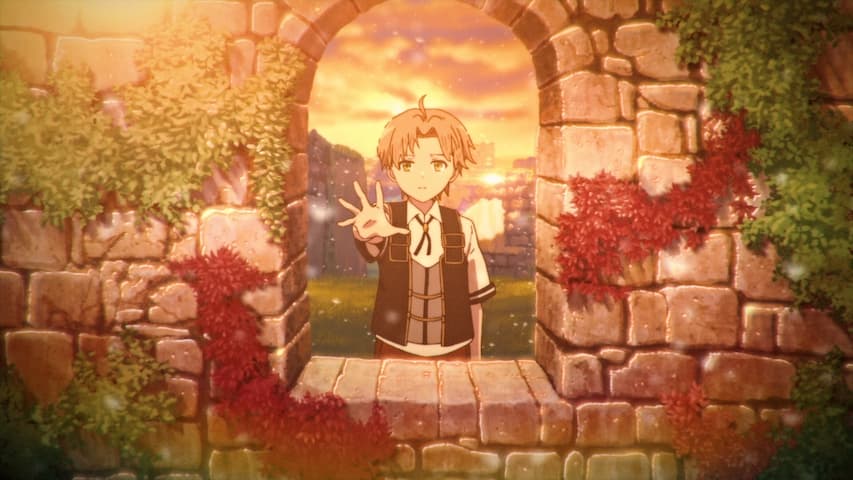
To bring it all back to Xenoblade Chronicles and really make it clear what I mean by any kind of complexity being wasted on me, here are all the crimes I committed. But first things first, I did enjoy playing the game, or else I wouldn’t have spent 50 hours of my life on it. But while I think the gameplay integration is good and necessary, at the end, I was mostly in it for the story. With that being said, Xenoblade Chronicles has so much going on at all times and you can ignore a not insignificant amount of it.
Take the entire network of mechanics that apply when doing any kind of battle. Xenoblade Chronicles has a very intricate system for fighting, which gets further enriched by the characters' skills, arts and affinity, as well as their equipment. First off, you yourself have the choice of controlling one of seven characters, each one having different sets of stats, basic functions and attacks that can be used in battle. Above that, two other characters controlled by the AI can be placed in your party. I did not experiment with the other characters or party composition. I always played as Shulk and put Dunban and Riki in the party solely on vibes. The game only forces you to control other characters just two times, so there was no incentive for me to learn or play as another character. A side effect of only using the same characters is that the affinity mechanic was left on the wayside, effectively shutting me off from the “Heart-to-Heart” stories.
Needless to say, I could not really explain to you what the majority of battle arts actually do. Shulk at least doesn’t learn anything beyond the eight available art slots, but every other character has simply kept their first eight default arts they learned, never utilizing newly learned arts, because those things are a lot to consider. Each art has a physical and several elemental split, whether it targets an enemy, oneself or a party member, whether it targets single or multiple enemies and the area the attack hits, as well as how close you have to be to the target. Then comes the actual damage with a minimum and maximum damage range, the cooldown time of the art and lastly the list of additional effects and possible conditions for the attack and extra effects. The effects, statuses, buffs and debuffs are another mechanic I essentially ignored beyond the thought that applying them to the enemy is probably a good thing, but they did not factor into my battle tactic at all. In fact, my battle tactic can be summed up by standing behind an enemy and waiting for the “Back Slash” art to cool down or spamming all the other damage arts once they were available. Aggro didn’t really mean anything to me and movement was also only limited to if I wanted to hit the double damage effect of “Back Slash”.
Even the Chain Attack, where I had full control over the arts of the other two party members, were just a shorthand for me to deal out damage faster. This is probably the biggest shame for me, because it is very easy for me to imagine doing a lot of cool and interesting stuff with each character’s arts to deal with different enemies very elegantly and also cause them to be less monotonous, but when you have to fight quite literally over a thousand of those, dealing out a lot of damage in the least amount of time with the least amount of complicated inputs became essential, otherwise I simply would not have gotten through all those fights. In fact, around halfway through the game, I switched to Casual Mode, not because the battles were too difficult, but just so I would spend less time on them. What the Skills and Skill Links are concerned, I basically unlocked them randomly and din’t pay much attention for what they would be useful.
Lastly, there is the equipment and how it influences the characters stats. There is one weapon slot and five armor slots, with the weapon slot mostly affecting your offensive stats and the armor doing the same for defense. So far so simple. Both have a split between physical and ether, so the best equipment is a lot more character and context dependent. Additionally, each equipment has gem slots, with the weapon having up to three while the armor tends to have either one or none. Also, some equipment comes with a gem linked to it, so it can’t be freely chosen. There is a gem for basically every single thing that can influence some aspect of the battle mechanic and every gem is unique in its strength of effect. This ranges from a general buff to the characters strength stat to resistance for one specific status effect to even time-based stuff. My problem, beyond it being a bit of hassle to deal with all the equipment and especially the gems, as you constantly get new stuff (And let’s not talk about the gem crafting being its own kind of beast), is that I couldn’t figure out if caring about the equipment even mattered. The weapon and armor seem to only give a flat bonus to your stats, which in themselves are a bit of a mystery and in the grand scheme of things, the equipment bonus barely makes a difference. The gems at least scale properly with your character or the effect, but considering how specific they tend to be, they also don’t do anything most of the time. I eventually stopped touching the equipment screen all together as it mostly seemed like needlessly intricate micromanaging and the only stat that actually seems to matter in this game is your level.
And those are just the battle mechanics. This game has so much more, that I at best only scratched the surface of, before turning back. I am well aware that some of my problems are made worse by the game itself not implementing a plethora of mechanics that well, in my opinion. But even when everything were to my liking, it still wouldn’t change my approach that much. There is so much you can do in Xenoblade Chronicles to truly make the game your own and I am just sitting here being like… yeah, I’m fine. And this is frustrating, because I feel like I shouldn’t be. I wouldn’t go as far as to say that I fundamentally played the game wrong, but I certainly played it differently to how it is intended and I can’t fully dismiss the thought that I would have more fun, if there wasn’t this mental blockade that kept me from engaging in a game to its fullest.
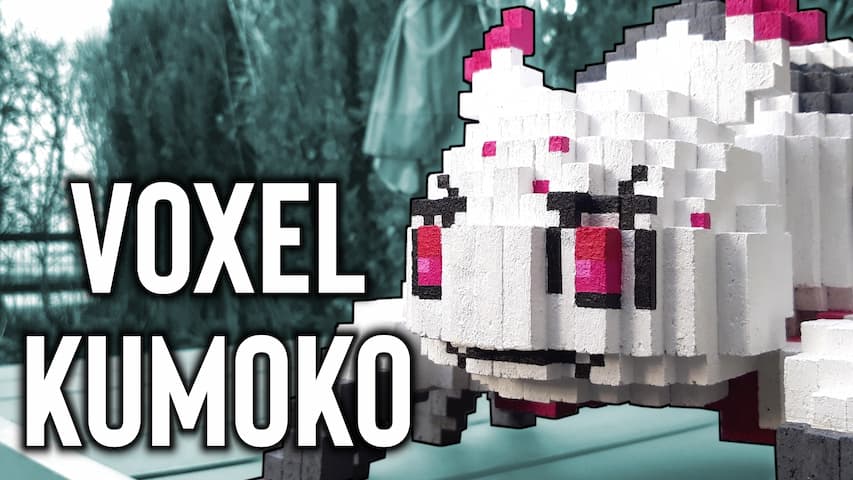
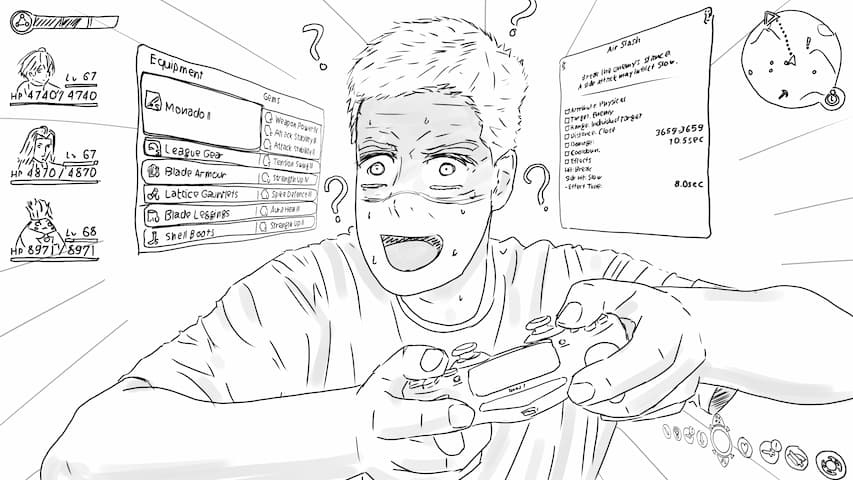
So yeah, that was basically my rambling about how I may not be bad at video games, but also am kinda bad at this whole playing video games properly. Or in easier terms that would have saved me writing an entire article: Anything more complicated than Pokémon is above me. I initially didn’t even plan to write that much about Xenoblade specifically, but it is simply one of the games where I can best describe everything that bothers me about specifically me playing games. Also, do not ask me what compelled me to create this thumbnail.
Related Posts
Comments